The 3pm Ceremony: Honest Church Wedding Photos When the Light Has Gone
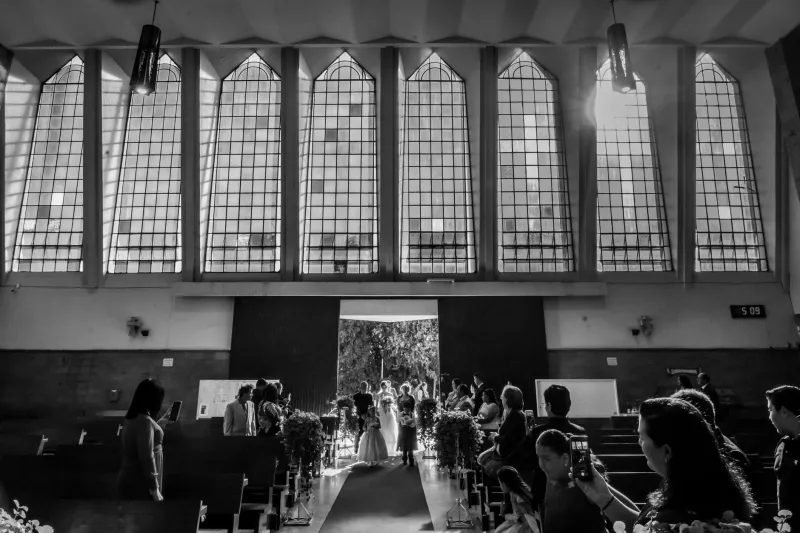
A British church wedding in January can be beautiful and brutally dark. You arrive at 2:30pm, the light is already going, the stone is cold, the windows are glowing and the vicar politely confirms that flash is not allowed. This is not a disaster. It is a brief. The job is not to fake a summer afternoon. The job is to make the real building, the real light and the real people look clear, warm and honest.
Start with the vicar, not the camera
Before you think about ISO, ask what is actually permitted. Some churches allow flash during the entrance and exit but not during vows. Some allow no flash at all. Some are relaxed about movement; others ask photographers to stay in one spot. Ask about silent shutter, communion, readings, the register signing and whether you can stand at the back or the side. Every church is different, and a two-minute conversation saves a lot of apologetic shrugging later.
Arrive early enough to test the room. Take a grey card or a white piece of card into the aisle. Check where the tungsten wall lights fall and where the daylight from the windows lands. Look at the ceiling, the stone and the pews. If the church has new LED fittings, test for flicker before the ceremony starts. It is much easier to fix a setting than a whole ceremony of banded frames.
Build a low-light setup that behaves
For most winter church ceremonies, manual exposure with auto ISO is the sane choice. Start around 1/125sec at f/1.8 to f/2.8, and let ISO float between 3200 and 6400 on a full-frame body. If people are moving, push the shutter to 1/160sec and accept the noise. A sharp, slightly grainy frame beats a smooth blur. On APS-C, expect to work a stop or so higher, and be realistic about what your files can take.
Use single-point or eye-detection autofocus and keep it on the face that matters. Do not let the camera choose the brightest stained-glass window as the subject. Shoot RAW, use both card slots if you have them, and avoid chimping through the vows. The screen will look brighter than the file and tempt you into wrong decisions.
Image stabilisation helps with your own handshake, but it will not freeze a bride turning to look at her mum. Brace yourself against a pew, breathe out slowly and take two frames of important moments rather than one hopeful one.
Lenses for stone, glass and small gestures
A 35mm f/1.4 or f/1.8 is the workhorse for the aisle, the back of the church and the wider atmosphere. A 50mm f/1.8 is lovely for vows and readings. An 85mm f/1.8 lets you stay out of the way and still catch faces and hands. If you prefer zooms, a 24-70mm f/2.8 is the safe compromise, but do not pair it with a slow telephoto and hope for the best.
Take two bodies if you can. Swapping lenses in a dark, crowded church is how you miss the kiss. Keep one wide and one tight, and resist the urge to shoot everything at f/1.2. Very shallow focus in low light is a gamble, especially when the couple are moving and the church is full of distractions.
The stained glass is part of the story. Expose for skin and let the windows glow. If they clip slightly, that is usually fine. What you do not want is a grey-faced couple in front of perfectly exposed glass. Meter for the face, use exposure compensation when the window dominates the frame, and do not turn the ceremony into an HDR exercise.
The mixed-light problem
British churches often mix warm tungsten, cool daylight and whatever colour the stained glass throws in. Set a custom white balance from a grey card in the aisle, then lock it. Auto white balance will drift every time a window enters the frame, and you will spend the edit chasing your own camera.
Aim for a neutral starting point around 3200K to 3800K, depending on the room, and fine-tune later. Do not try to make the tungsten lights look like daylight. Warm light on stone is part of the atmosphere. The important thing is that skin stays believable, not orange and not strangely green.
Editing for honest skin without flattening the building
Start in RAW and correct white balance per scene, not per frame. If the couple move from the aisle to a side chapel, the light changes. Use local masks on faces rather than global sliders that lift the whole church into a flat grey box.
Lift shadows gently. Keep some depth in the pews and the stone. Reduce noise with care, because smeared faces look worse than a bit of grain. For skin, check the reds and oranges in HSL. A small reduction in orange saturation often does more than a heavy skin mask. Compare faces against a neutral reference, ideally in daylight-balanced viewing conditions, and resist the urge to add a golden glow that was never there.
Let the stained glass stay rich. Let the stone stay slightly cool. Let the tungsten stay warm. If the couple wanted summer brightness, they would have booked a barn in July. They booked a winter church, so give them the winter church.
Brief the couple in plain English
Before the day, tell them what the photographs will feel like. Not gloomy, but atmospheric. Not flash-bright, but clear. Explain that the church will be darker than the photographs they see on social media, that grain may be visible in the album, and that you will work quietly and respectfully during the ceremony.
If the timetable allows, suggest an earlier ceremony or a short portrait session before the light drops completely. Check the sunset time for the date and build in ten minutes for group photos near the church door or a bright window. Ask the vicar where those group shots can happen without blocking the aisle or upsetting the organist.
A short shot list that works in gloom
Get a wide frame from the back before the entrance. Catch the couple at the door, the walk down the aisle, the hymns, the readings, the vows, the rings and the first kiss. Photograph hands and faces rather than every pew. If the register signing is allowed, use it for quiet moments. Then get out of the way for the exit.
A second shooter is a luxury in these rooms, but if you have one, put them at the front-left or front-right and keep them still. Two angles are better than one photographer clomping up the aisle.
The result will not look like a bright summer wedding, and that is the point. A dark church in winter has its own drama: the glass, the stone, the candle-warm faces and the sense that everyone is gathered close together. Shoot for that, edit for that, and the photographs will be honest, clear and worth keeping.